
The Tale of Two Balls
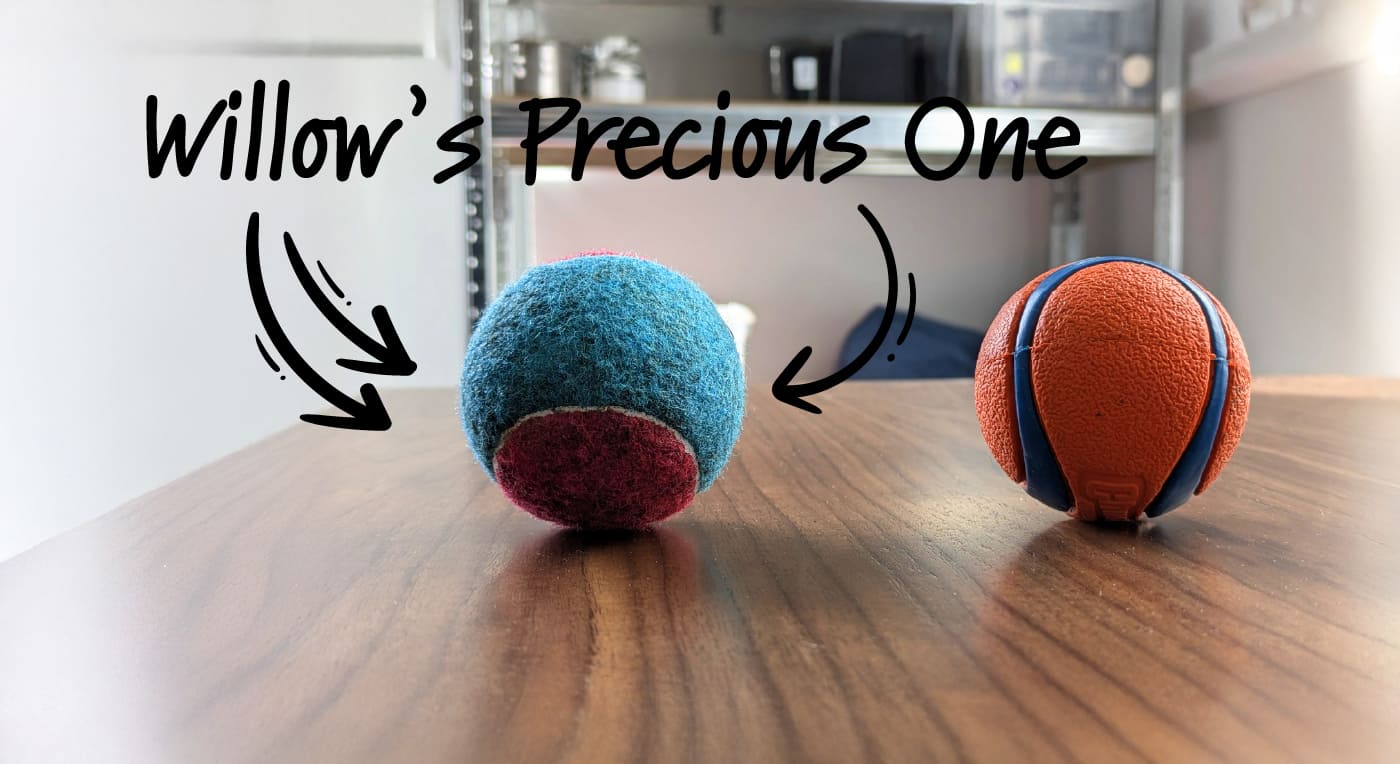
Willow’s not really that into balls.
Well, sometimes she is. For about three throws.
Maybe four if you’re lucky and she’s feeling generous.
Or if her brother wants it.
I could buy her the fanciest ball on the market, and chances are by halfway through the walk she’ll have dropped it in a puddle and moved on to sniffing mouse holes in the grass.
But the other day, something magical happened.
We were walking through the meadow near the park, Willow off in the long grass doing what she loves best, head down, nose on, fully immersed in the invisible world of scent trails. When suddenly, she popped out with something clamped proudly in her mouth.
A tennis ball.
Purple and blue.
Perfectly intact.
And very much not ours.
One Dog’s Lost Ball Is Another Dog’s Treasure
Now, here’s the thing: I’ve given Willow plenty of balls.
She’s polite about it—takes it, might chase it once or twice, but she’s not obsessed.
This ball though?
This ball was treasure.
She carried it the whole walk. Trotted with her head held high.
Taunted Mason (the brother, from the same mother) with it. Guarded it like it had ancient powers.
And she would’ve taken it to bed with her if I’d let her.
So… what changed?
It was still just a ball, right?
Wrong.
So, When Is a Ball More Than Just a Ball?
When your dog finds it.
Because when Willow discovered that ball for herself, hidden in the grass, scented with stories, it became something far more valuable than a mass-produced toy from a shop.
Let’s break it down:
- Tennis balls have a distinct whiff: rubber core, glue, synthetic fibres
- Then add the scent of another dog’s slobber, human skin cells, and the environment it had been rolling around in
- All of that, to a dog’s nose, is rich, complex, fascinating
To us? It’s a tennis ball.
To Willow? It was a scented time capsule. A reward she sniffed out all by herself.
And the act of sniffing and finding? That’s where the real magic happens.
The Science Bit: The Seeking System
There’s a reason dogs come alive when they’re searching.
Inside every mammal’s brain is something called the seeking system, a network that drives curiosity, exploration, and the desire to find things. Mostly the things to do with survival like food or finding a mate.
It’s linked to motivation and reward. When it’s activated, it feels good. Dopamine (that lovely feel-good chemical) starts flowing, and your dog becomes engaged, switched on, and happy.
This system is what makes scent work so powerful. It’s not just about the thing they find, it’s the process of searching, exploring, and achieving that lights them up. It is good for the mental well-being. And that means, it is good for ours too because there is nothing better for you than seeing your dog happy.
So, when Willow found that ball?
She wasn't just retrieving. She was satisfying a deep, biological need. The anticipation and reward from searching and finding.
The Value of Found Things
We often assume that we need to provide the fun. That enrichment means buying new toys, trying new activities, coming up with games.
But sometimes, the most powerful thing we can do is… let them find it themselves.
Because for dogs, value isn’t always in what we offer.
It’s in what they discover on their own.
That ball, because she sniffed it out, uncovered it, chose it, was hers in a way no bought toy ever could be.
What We Can Learn From Willow’s Ball
- Searching adds value: Let your dog find things. Don’t always hand it to them.
- Enrichment doesn’t have to be complicated: Sometimes, it’s hidden in the long grass.
- Every walk is an opportunity: Not just for exercise, but for exploration.
- Dogs need to use their noses: It’s not optional. It’s who they are.
- The journey matters more than the object: For dogs and, let’s be honest, often for us too.
So, the next time your dog finds half a chewed tennis ball, or a long-forgotten toy in a hedge, or a stick that looks like every other stick you’ve ever seen…
Pause before you take it away.
Because to them, it might not be “just a ball.”
It might be treasure.
It might be joy.
It might be their own little win.
And they found it, nose first.